
BCAM Post 6: Side effects
Raising awareness in Breast Cancer Awareness Month

This feels like the hardest of all these BCAM posts to write. I’ve tried to make the others as based on science and research as possible, but this one is so personal to each of us living with MBC, and there’s no science or research that can capture the catalogue of side effects that each of us are living with. I won’t even get close here, and I have concerns about getting the balance right and not missing important things out, but I’m accepting that I probably wont (get the balance right) and will (miss things out).
So I’m just going to try to give a glimpse. Any readers also living with MBC, feel free to add your own experiences in the comments – really only you can say how this has affected you, physically, emotionally and in terms of your way of life.
Cancer takes a toll. The physical impacts are many, and are often significant and debilitating and life-changing. Pain (from constant niggles to severe), reduction of function in organs or skeletons, loss of body parts, changes of all kinds, loss of a physically recognisable self.
The treatments take a toll. Surgeries are invasive and bring many consequences. The drugs are toxic and not kind to the body. You can read more about them here and here and in the resources below, but I’ve heard of so many side effects not listed in any reading. Just to give you an idea of the complexity of what MBC patients deal with in terms of side effects, even Denosumab, the bone strengthener I receive, is not mild in its effect. It works to counteract thinning, brittle bones but also makes them more rigid in the process, reducing mobility (ironically also potentially causing fractures), and can cause skin conditions, urinary problems, blood clotting, stomach problems, fatigue and jaw necrosis (where parts of the jawbone die, which I fear a lot). Each of our drugs has a plentiful list such as this.
For many people MBC treatment brings, in the words of my oncologist, ‘a handbrake turn into menopause’. It’s an enormous shock to the system, as the hormones are suddenly forced out of our bodies rather than dropping at a natural pace, which often make the symptoms of menopause more severe and intense. We can’t take HRT, as we need to keep our bodies hormone-free – one of the many ways we’re set apart from many of our peers following this diagnosis (another side effect). Brain fog, painful joints, vaginal dryness, painful sex, loss of libido, urinary tract infections, hot flashes, mood swings, fatigue, poor memory, weight gain, dry skin, brittle bones … this becomes a way of life and, for many younger women living with MBC, it also of course means the devastating loss of fertility. (And I don’t know about others, but apart from being told it was going to happen, I was given no information or support to deal with medical menopause at all.)
Loss is the theme of MBC side effects.
Loss of a body we recognise or feel full ownership of. My body no longer feels entirely my own. It’s a pincushion and something to be scrutinised and surveilled and examined in whole new way. My body is in the hands of other people, literally and metaphorically.
Loss of so many different kinds of freedom. Freedom to plan – the scan cycle means time becomes measured in short spans in which we trust we will stay well, or well enough, or be less ill than we might be. Oh how I long for the freedom to imagine and prepare for future adventures. To feel confident in arranging something a year ahead. To not fear any physical niggle. To wake up with the relative innocence of not knowing what’s going to happen to me or when. To not have to factor in hospital visits to my calendar. To assume I will know my grandchildren. To not have to consider a compromised immune system into what I can do and where I can go. To travel without having to ask a doctor’s permission, know something about a country’s healthcare system, take drugs, extra antibiotics, a thermometer and proof of my illness with me, to not worry whether I can afford the insurance. (We can only guarantee travel insurance from scan to scan, and it can be wildly expensive. If you’re a UK cancer patient looking for affordable insurance, contact Insurance With set up by fellow MBC patient Fi McCrae with the explicit aim to help make it affordable enough for people with medical conditions to have both adventures and rests away from it all. What a gift she has given so many of us.)
Loss of a professional life. For many MBC patients, both personal and career plans end or have to be redrawn with new limits. Having cancer is a job in itself and it takes up physical, mental and emotional energy which simply doesn’t leave brain space that we had before. Many of us do continue to work and and cancer is a protected characteristic so it’s illegal for employers to discriminate against us, but the ability to emotionally invest in long-term career plans changes. I had a 20-year work plan when I was diagnosed, that has largely been decimated. It’s been devastating.
Loss of old age. As I said at the start of these posts, MBC is now the biggest killer of women between 35 and 64 in England and Wales. That’s young. It’s pre-retirement. We lose those years so many of us hope for – the retirement years. (Another thing that sets us apart from our friends in so many conversations.) I know that getting old is not a walk in the park, but we MBC people are desperate for it.
Loss of relationships. This is a whole post on its own. I don’t know anyone living with MBC who hasn’t had it change their relationships with people around them. We’re not the same as we were, and we’re not the same as people living without MBC, and some people can accommodate this and some find it harder.
Loss of income. Having cancer is expensive. As I said, few people I know are able to work as much as they did before cancer, many not at all. And though places such as Penny Brohn, Maggie’s or Macmillan centres and Future Dreams House in London offer integrative and complementary therapies, the time-limited nature of them doesn’t always touch the sides of what’s needed when you’re living with cancer long-term. I have different treatments to manage different symptoms, emotional and physical. Treatments and supplements for painful joints, drying, cracking and itchy skin, breaking nails, thinning hair, mouth ulcers and a whole load of other things don’t come cheap. Neither does therapeutic support – cancer is a trauma and we need support to manage that. Research has shown that exercise is transformative in maintaining wellness during cancer treatment, especially for maintaining strength and bone density when osteoporosis is a very real threat. (This Substack is brilliant on the importance of exercise in cancer treatment.) But exercise is not easy to access with a body that houses damage, and most of us need help to do this safely. Again, this costs, and it’s prohibitive for so many people. My cancer manifesto would without doubt offer ongoing therapeutic support, menopause support and ongoing personal training for all MBC patients.
Chemotherapies that cause the obvious visible side effects of cancer tend to be later lines of treatment for MBC patients, and don’t come at all for some people. It means many of us living with MBC look very much the same as we did before, which can be confusing. The side effects we’re living with go unseen, though they gradually set us apart. If you do know someone living with MBC, remember that their lives have irrevocably changed, and that they’re dealing with it on a daily basis, even if their lives look more or less the same as before. Be curious and compassionate – they may not want to talk about it but knowing they can will be so welcome. MBC is a handbrake turn into change, loss and grief of so many kinds.
Hmmm. This feels like a long post but also one that’s barely skimmed the surface, or done justice to the subject. But I hope it’s useful, in some way.
The main takeaway? Cancer’s a fucker.
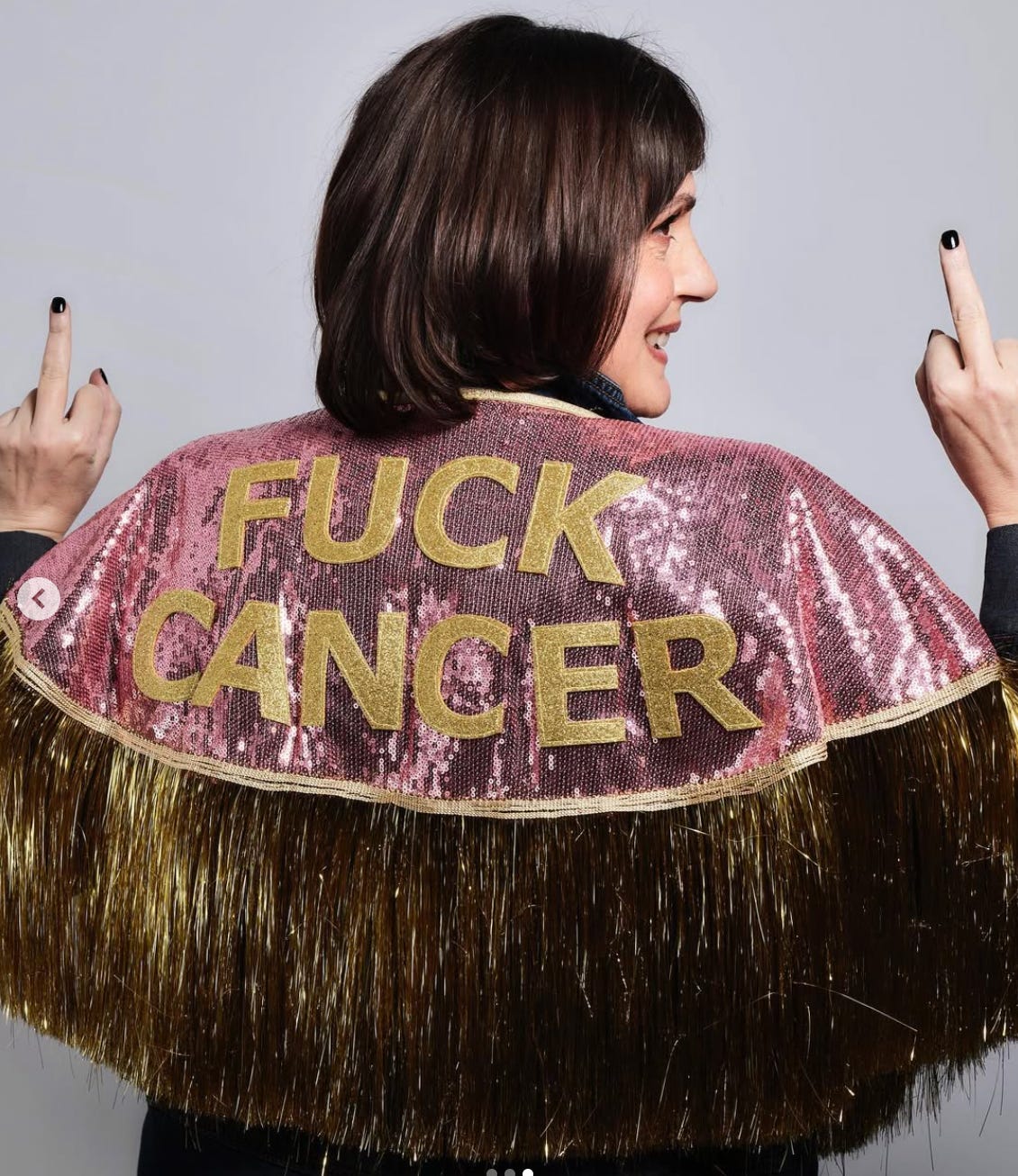
My beautiful friend Paola, who died in 2024.
We’ve reached the end of BCAM, but there is one more post to come (I hoped to get them all into October but haven’t quite managed it) on the state of things for MBC patients in the UK currently. I don’t want to miss it out, as it’s an important part of the picture and will be similar for other illnesses too. So bear with me – nearly there!
Need something to throw my arms in the air to after all that.
Let’s celebrate freedom with beautiful George. Never fails to bring me joy.
xxx
God that was a hard read, but nothing as hard as for you to write or to bare and live with….. I feel ignorant and ashamed that I haven’t informed myself better, especially after reading what you have to contend with, research, understand, decide, ignore and bare and bare and bare. You’re a titan Ms Skelton, a bad ass, wisdom keeper, and phoenix of epic proportions. I love you and am by your side. Every muddy messy step of it!!!!! 💚
Thank you Helen for your series . They are all informative and written with your customary eloquence. Thank you for your bravery and honesty. Bloody love you x